SURE CURE WELLNESS × Personal Fitness
THE LIFTER’S LOW BACK GUIDE
Why your back flares after deadlifts — and how to build it back stronger
WHAT IS INSIDE
| Section | What You Get |
|---|---|
| 1. What is actually going on | Why it hurts — in plain language, not textbook language |
| 2. The four usual causes | Which one is driving yours |
| 3. Red flags | When to stop training and get it checked |
| 4. What to bring to your trainer | The information your Personal Fitness trainer needs to program around it |
| 5. How it actually gets fixed | Treatment options and who handles which part |
| 6. When to get it assessed | The point where guessing stops working |
One rule before you start: Pain at 0-3 out of 10 during training is acceptable and will not harm you. Pain above 4, or pain that is worse the next morning, means you did too much. That is the signal to scale back — not to stop entirely.
1 · WHAT IS ACTUALLY GOING ON
Most gym-related low back pain is not a disc herniation and not permanent damage. It is usually irritated tissue combined with a nervous system that has become protective. Your back is one of the most robust structures in your body — it is built to load. The problem is almost never that you lifted. It is usually how much, how fast, or how fatigued you were when you did. Avoiding loading entirely deconditions the exact tissue that needs to get stronger.
2 · THE FOUR USUAL CAUSES
| Cause | What It Means For You |
|---|---|
| Fatigue-driven form breakdown | The injury rarely happens on set one. It happens on the last set when position degrades and you push anyway. |
| Hips that do not hinge | If the hips do not move, the lumbar spine does. That is the single most common mechanical driver. |
| Weak or poorly timed bracing | Bracing is a skill. Without it, load transfers straight into passive structures instead of through the trunk. |
| Prolonged sitting outside the gym | Eight hours of sitting followed by heavy hinging is a load the tissue is not warmed up for. |
3 · RED FLAGS — STOP AND GET IT CHECKED
| If You Have This | Why It Matters |
|---|---|
| Numbness or tingling down the leg past the knee | Nerve root involvement. Needs evaluation before further loading. |
| Weakness in the leg or foot — tripping, foot slapping | Motor involvement. This is not a training problem. |
| Any change in bladder or bowel control | Medical emergency. Go to an emergency room immediately. |
| Numbness in the groin or inner thigh | Same as above. Emergency evaluation. |
| Severe pain after a fall or direct trauma | Rule out fracture before doing anything else. |
| Night pain, fever, or unexplained weight loss | Requires medical workup, not rehab. |
4 · WHAT TO BRING TO YOUR PERSONAL FITNESS TRAINER
You do not need to stop training. You need your programming adjusted around the tissue that is irritated — and that is exactly what your Personal Fitness trainer does. Your job is to give them good information. Show them this page and tell them which movements provoke it. They will handle the rest: the swaps, the loading, the form, and the progression back.
| Movements That Commonly Provoke It | Ask Your Trainer About |
|---|---|
| Heavy conventional deadlift | Trap bar deadlift from blocks · Romanian deadlift at 50% load · hip thrust |
| Barbell back squat, heavy | Goblet squat · box squat · leg press with neutral spine |
| Loaded spinal flexion (sit-ups, weighted crunches) | Dead bug · bird dog · side plank · Pallof press |
| Bent-over barbell row | Chest-supported row · seated cable row · single-arm dumbbell row with support |
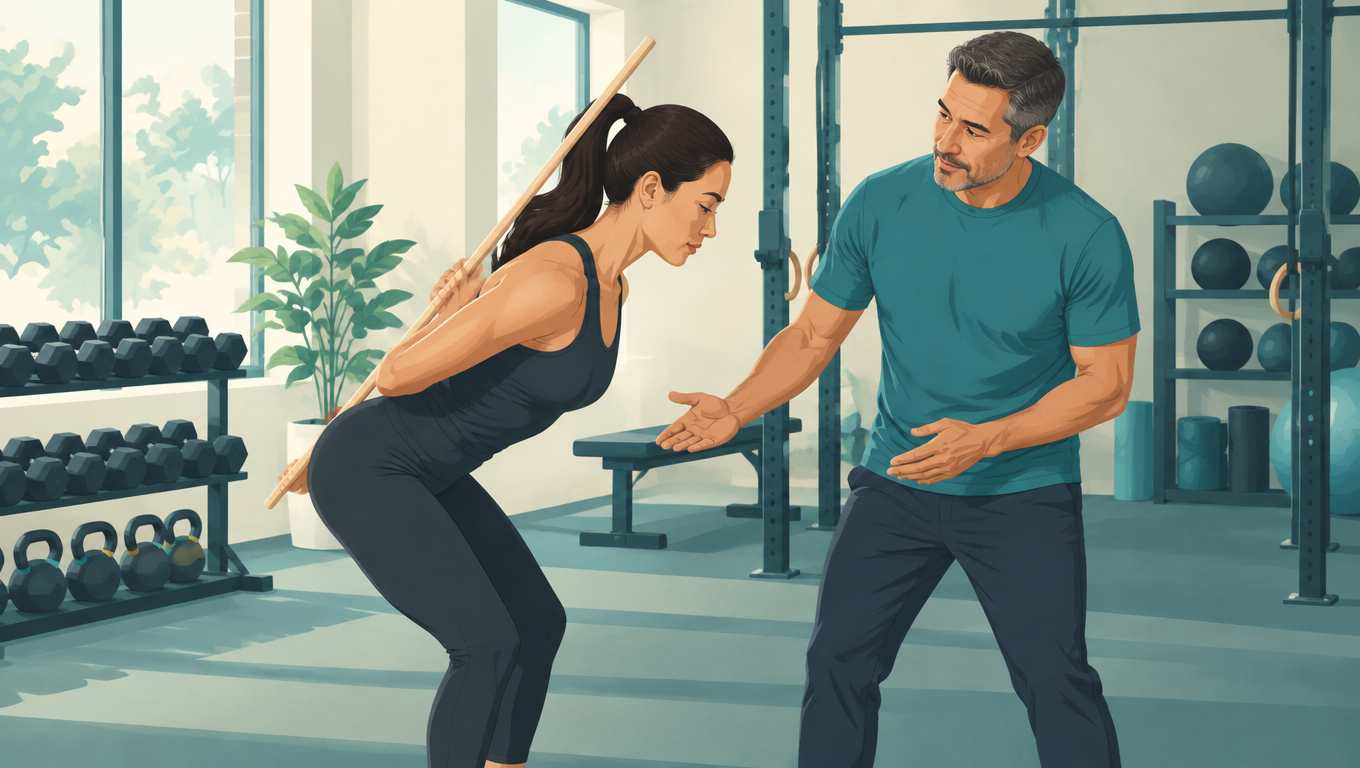
| Good mornings | Hip hinge with a dowel on the back for feedback, bodyweight only |
| Overhead pressing while standing | Seated press with back support · landmine press |
The second column is a starting point for that conversation, not a program. Your trainer knows your history, your goals, and your technique — they will pick the right variation and coach it properly.
KEEP TRAINING THESE
Walking — the single best thing for an irritated back · All upper body with trunk support · Split squats and lunges if pain-free · Carries at moderate load · Bike and rower if comfortable
The Two-Week Rule. If the pain is unchanged after two weeks of modified training, it is not going to resolve on its own. That is the point to get it assessed — not after six more months of working around it. Early treatment means a shorter fix and less lost training.
5 · HOW THIS ACTUALLY GETS FIXED
Adjusting your training buys you time and keeps you in the gym. It does not always resolve the tissue itself. When irritated tendon or muscle has been there for months, it usually needs direct treatment alongside the training changes. Here is what that looks like.
| The Three Pieces | Who Handles It |
|---|---|
| Load management and programming Adjusting volume, range, and movement selection so the tissue is not re-irritated every session | Your Personal Fitness trainer. This is their lane and they are good at it. Give them the information from section-4 and let them build it. |
| Treating the tissue Addressing the tendon or muscle that has stopped responding to rest and training changes alone | Sure Cure. Hands-on treatment, shockwave therapy, and dry needling — described below. |
| Finding the real cause Identifying the movement fault, mobility limit, or load pattern that started it | Both. We assess it clinically and send the findings to your trainer so it does not come back in four months. |
TREATMENTS AVAILABLE AT SURE CURE
| Treatment | What It Is | Used For |
|---|---|---|
| Shockwave Therapy | High-energy acoustic waves delivered through the skin to the affected tendon or tissue. It stimulates blood flow and the body’s own repair response in tissue that has stalled. Non-invasive, no needles, no medication, no downtime. Sessions take about 10-15 minutes and you train the same day. | Chronic muscular and gluteal trigger point pain, and for hip tendon involvement that often travels with back pain. |
| Dry Needling | A thin filament needle placed directly into a trigger point or band of tight muscle to release it. Different from acupuncture — this targets specific muscular restrictions. Most people feel a noticeable change in range of motion within a session or two. | Deep glute, QL, and paraspinal tissue that stays guarded long after the original flare has settled. |
| Manual Therapy | Hands-on joint and soft tissue work to restore the movement the joint has lost. Usually combined with the above rather than used alone. | Used across all conditions, particularly where stiffness limits how you move under load. |
Most people notice a meaningful change within 3 to 5 shockwave sessions. It is not a single-visit fix, and anyone telling you otherwise is selling you something. What it does do is get tissue moving that has been stuck for months.
6 · WHEN TO STOP GUESSING AND GET IT ASSESSED
| Get It Assessed If | Why |
|---|---|
| Any red flag in section 3 applies to you | Those signs point to something that programming changes will not fix. |
| Two weeks of modification changed nothing | The tissue needs direct treatment, not just load management. |
| It keeps coming back every few months | Recurring pain means the underlying cause was never addressed. |
| You are not sure whether it is safe to load | A 15-minute assessment answers that question definitively. |
| You are avoiding lifts you used to do | Avoidance compounds. The longer you wait, the more you lose. |
WHAT AN ASSESSMENT AT SURE CURE LOOKS LIKE
| 1. We listen | What you train, what hurts, when it started, and what you have already tried. |
| 2. We test | Specific clinical tests that separate muscle, tendon, joint, and nerve as the source of the pain. |
| 3. We tell you straight | What it is, whether it is safe to keep loading, and what it will take to fix it. |
| 4. You leave with a plan | Written guidance you can take to your trainer, whether or not you treat with us. |
FREE 15-MINUTE ASSESSMENT
For Personal Fitness members
Introductory shockwave therapy session — $59
surecurewellness.com
4541 N Josey Ln, Suite 130, Carrollton TX 75010